









History of Clay

Minerals are the main source of life on our planet, and are imperative to our survival. Minerals are necessary for all processes in the body, including the assimilation of vitamins, fats, proteins, and carbs as well as biochemical functions that occur. Minerals help with everything from muscle contractions to the production of hormones. A natural source of all the minerals used and consumed by humans, for a variety of purposes, is clay.
Dating back to the prehistoric era, the earliest humans used clay to treat minor ailments such as food poisoning, aches and pains, infections, and mineral deficiencies. They even turned to clay for spa and beauty treatments.1
There are indications that homo erectus and homo neanderthalensis used ochres mixed with water and different types of mud to cure wounds, to soothe irritations, as a method of skin cleaning, etc. This might be due to their mimicking animals, many of which instinctively use minerals for such purposes.2
The first written reference known to exist upon the use of “stones,” and a description of their mineral benefits, dates to Rome, 60 BC. Throughout ancient history, clay has been used topically for soothing the skin, as well as internally for gastrointestinal issues. Aristotle (384–322 BC) made the first reference to the deliberate eating of clay, earth, or soil by humans (for therapeutic and religious purposes). Later, Marco Polo described how in his travels he saw Muslim pilgrims cure fevers by ingesting “pink earth”. This practice is still followed in certain countries and communities for therapeutic purposes, or even to relieve famine.3
Some uses of clay throughout ancient history include:
- Pharmaceutical formulations
- Oral applications
- Topical applications
- Gastrointestinal protectors
- Osmotic oral laxatives
- Anti-diarrheal
- Dermatological protectors
- Cosmetics
- Use as excipients
- Influence on the liberation process of drugs
- Influence in the drug’s degradation2
Still today, in societies that have not lost touch with nature, clays are used for preventative care, remedies, and minerals.4 American Indians use clays for their ceremonial healing procedures. African tribes use clay similarly. In his book, Nutrition and Physical Degeneration, Dr. Weston A. Price discusses several native cultures including those in the Andes, Central Africa and Australia who consumed clays in various ways. Many would carry balls of dried clay in their bags, and dissolve a small amount of the clay in water, to drink with meals, to prevent poisoning from any toxins present.5
What Exactly is Clay?
Clays are soft mineral substances; a product of weathered volcanic ash. Clay is formed as a result of volcanic activity subjected to environmental influences (physical and chemical) over a period of time. Clays differ in structure and composition depending upon the source. Just like there are no two identical fingerprints, it is impossible to find two identical clays. They come from different sources, each source with its own unique mineral compositions. Clays consist of tiny particles that can absorb large amounts of water. As a result, many clays can expand immensely upon hydration. Clays can absorb minerals and organic substances, such as metals.6
There is an electric charge created between the clay layers, as well as on the edge of its particles. This makes clays adsorb and absorb heavy and radioactive metals, free radicals and other unwanted products of metabolic activity.7
Each clay type has its own beneficial uses, dependent upon its origin, chemical composition, and properties. Clay contains some antibacterial properties as well. Minute particles envelope bacteria and deprive it of nutrition and oxygen. This property makes clay a natural antibacterial agent.8
Modern Uses for Clay
Clays have a well-deserved place in health and beauty routines. Widely used in spas, clay slurries are prepared by mixing with water (geotherapy), mixing with sea or salt lake water, or minero-medicinal water, and then matured (pelotherapy), or mixed with paraffin (para- muds).9
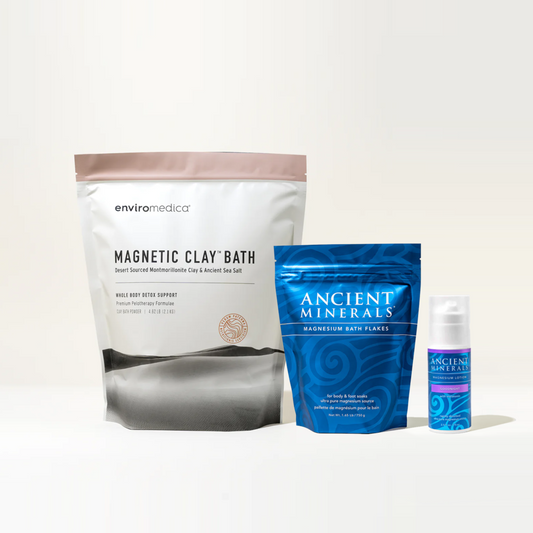
In geotherapy and pelotherapy the application form can be face masks, cataplasms, or mud baths, depending on the body area to be treated, and the temperature of the clay can be either hot or cold. Mud baths are used in spas and in beauty, when the mud is applied by submerging part of the body (bathing the arms, hands, or feet) or the whole body in a bowl or bath filled with a mixture of clay and water.
Bentonite Clay
A common clay used for skin conditions, as well as spa and beauty treatments is called Bentonite clay. Bentonite clay was discovered in large amounts in Fort Benton, near Rock River in Wyoming. Named after a formation there called Benton Shale, bentonite clay is formed after volcanic ash has weathered and aged in the presence of water. Bentonite has a strong negative electromagnetic charge, and when activated by water, it acts like a magnet in and on our bodies, drawing metals and toxins to it. When mixed with water it swells open like a sponge, and can absorb 40-50 times its weight. There are a few types of Bentonite clay which are named after the dominant element in them. There is sodium bentonite, calcium bentonite, aluminum bentonite, and potassium bentonite, each with unique benefits.10
Bentonite clay is now used in a variety of homemade skin care products. Some are made into products such as hair and face masks, homemade re-mineralization clay toothpastes and tooth powders, baths for drawing heavy metals away from the body, skin calming lotions, deodorants, soaps, and even makeup.
Although it is important to know your sources of clay and to learn the benefits and risks of use, clay can be a great addition to your health and beauty routines, with some amazing benefits!
References
- 1. St George, G. (2015) How Clay Works: Science and Applications of Clays and Clay-Like Minerals in Health and Beauty.
- 2. Carretero, MI, (2002) Clay minerals and their beneficial effects upon human health. Applied Clay Science (21), 155–163
- 3. Carretero, MI, (2002) Clay minerals and their beneficial effects upon human health. Applied Clay Science (21), 155–163
- 4. St George, G. (2015) How Clay Works: Science and Applications of Clays and Clay-Like Minerals in Health and Beauty.
- 5. Price, Weston A. (2009). Nutrition and Physical Degeneration.
- 6. Bergaya, F, Theng, BKG, & Lagaly, G (2006) Handbook of Clay Science. Developments in Clay Science, Vol 1 (11), pp117(25).
- 7. St George, G. (2015) How Clay Works: Science and Applications of Clays and Clay-Like Minerals in Health and Beauty.
- 8. St George, G. (2015) How Clay Works: Science and Applications of Clays and Clay-Like Minerals in Health and Beauty.
- 9. Carretero, MI, (2002) Clay minerals and their beneficial effects upon human health. Applied Clay Science (21), 155–163
- 10. St George, G. (2015) How Clay Works: Science and Applications of Clays and Clay-Like Minerals in Health and Beauty.


